
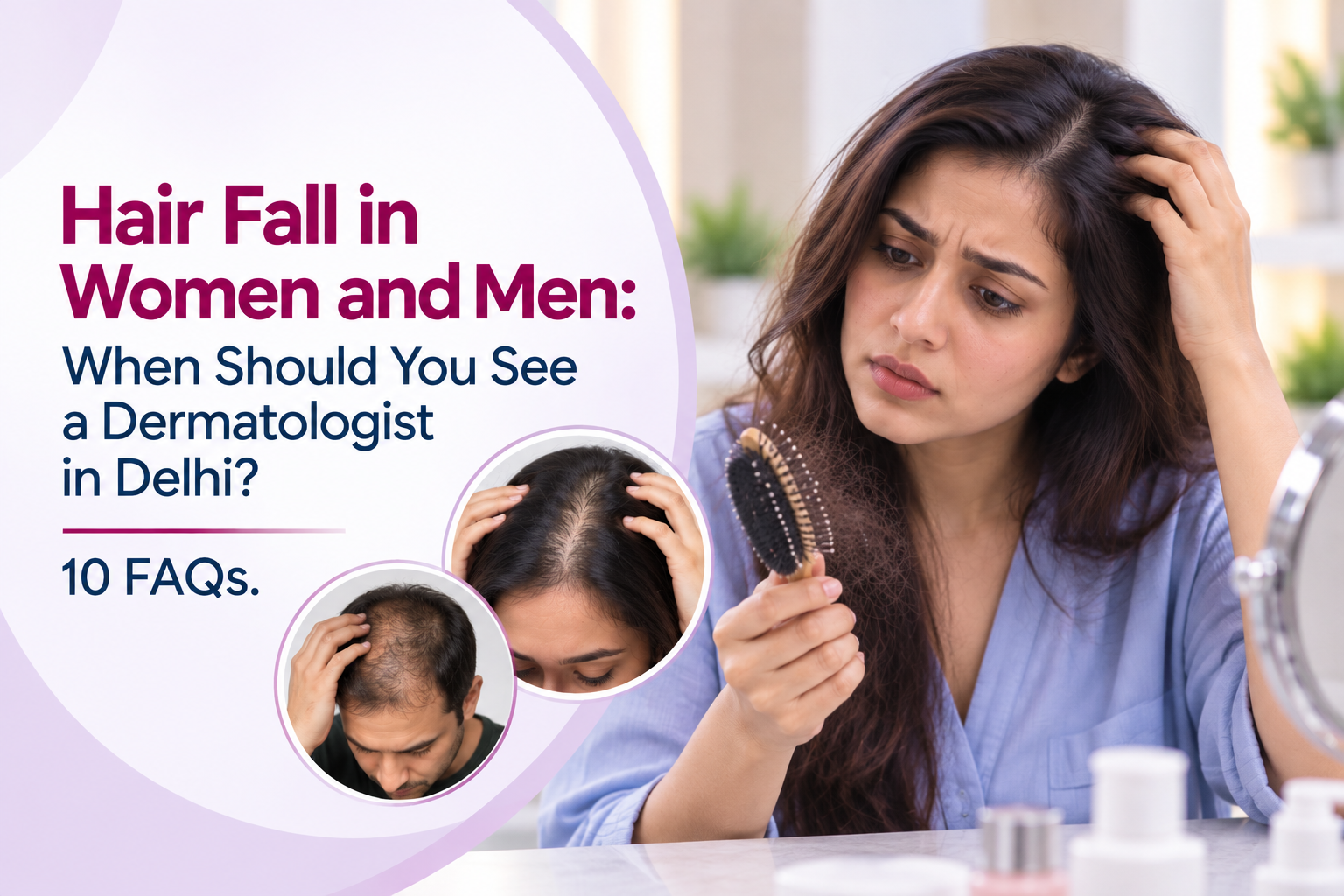
Everyone sheds some hair daily — it’s a normal part of the hair growth cycle. The confusion usually starts when shedding feels like “more than usual,” and it becomes hard to tell whether that’s a temporary phase or something that needs treatment before it progresses further.
This FAQ guide, from Dr. Rashmi Sharma, Senior Consultant Dermatologist at Fortis Hospital, Vasant Kunj, answers 10 common questions about hair fall in both women and men, and when it’s time to seek hair fall treatment in Delhi.
1. How much hair fall is considered normal?
On average, losing 50 to 100 hairs a day is considered within the normal range, as part of the natural hair growth cycle. It’s worth paying closer attention if you notice:
- Hair fall that’s clearly increased from your personal baseline
- Visible thinning, especially at the crown or along the parting
- Clumps of hair coming out during washing or brushing, more than usual
- Hair fall that’s persisted for more than 2-3 months without improvement
Tracking this over a few weeks — even informally — gives useful information for your dermatologist if you do seek evaluation.
2. What causes hair fall in women?
Hair fall in women often has multiple contributing factors, including:
- Hormonal changes — pregnancy, postpartum shedding, menopause, or conditions like PCOS
- Nutritional deficiencies — particularly iron, vitamin D, and protein
- Thyroid dysfunction
- Stress-related shedding (telogen effluvium), often triggered by illness, major stress, or significant life changes
- Genetic (androgenetic) hair thinning, which can affect women as well as men
Because the causes vary so widely, treating hair fall effectively usually starts with identifying which of these is the actual driver in your case.
3. What causes hair fall in men?
In men, hair fall most commonly relates to:
- Androgenetic alopecia (male pattern hair loss) — genetically driven, typically starting at the temples or crown
- Stress or illness-related shedding, which is usually temporary
- Nutritional deficiencies
- Scalp conditions, such as dandruff or fungal infections, if not managed properly
- Certain medications, in some cases
Male pattern hair loss tends to be progressive if untreated, which is why earlier evaluation generally allows for more treatment options and better results than waiting until thinning is advanced.
4. When should hair fall be evaluated by a dermatologist?
Consider booking a consultation if:
- Hair fall has clearly increased and persisted for more than 2-3 months
- You’re noticing visible thinning or a widening parting
- Hair fall is accompanied by scalp itching, flaking, or redness
- There’s patchy hair loss rather than generalized thinning
- Over-the-counter hair products haven’t made a noticeable difference
Earlier evaluation matters because many causes of hair fall are more effectively treated before significant thinning has occurred.
5. What tests might be recommended for hair fall?
Depending on your history and pattern of hair fall, a dermatologist may recommend:
- Blood tests — checking iron levels, ferritin, thyroid function, and vitamin D
- Hormonal tests, particularly for women with irregular cycles or other signs suggesting PCOS
- Scalp examination, sometimes using dermoscopy (trichoscopy) to assess hair follicle health and pattern
- In select cases, scalp biopsy, if the diagnosis remains unclear after initial evaluation
This workup helps distinguish between temporary shedding, hormonal causes, and genetic pattern hair loss — each of which is managed differently.
6. What treatment options are available for hair fall?
Treatment depends on the underlying cause, and may include:
- Topical treatments, such as minoxidil, for pattern hair loss
- Oral medications, in appropriate cases, particularly for hormonally-driven hair loss
- Nutritional supplementation, if deficiencies are identified
- PRP (Platelet-Rich Plasma) hair treatment, which uses your own blood plasma to stimulate hair follicles, often used for pattern hair loss and general thinning
- Mesotherapy, in some cases, to support scalp and follicle health
Dr. Sharma’s practice offers PRP hair treatment alongside medical management, allowing a combined approach depending on your specific diagnosis.
7. How does PRP hair treatment work, and who is it suitable for?
PRP treatment involves drawing a small sample of your own blood, processing it to concentrate the platelet-rich plasma, and injecting it into the scalp to stimulate hair follicle activity. It’s generally most effective for:
- Early-to-moderate pattern hair loss
- Cases where hair follicles are still present but thinning, rather than completely inactive
- As a complementary treatment alongside medical management
PRP typically requires a series of sessions, with results building gradually rather than appearing after a single treatment — your dermatologist can advise whether you’re a good candidate based on your specific pattern of hair loss.
8. How long does hair fall treatment take to show results?
Hair growth is a slow biological process, so patience matters considerably here. Most treatments — whether topical, oral, or PRP — typically take 3 to 6 months to show visible improvement, since hair follicles need to complete a growth cycle before new growth becomes noticeable. Stopping treatment too early, before this window has passed, is one of the most common reasons people feel hair fall treatment “isn’t working.”
9. Can stress-related hair fall be reversed?
Often, yes. Stress-related shedding (telogen effluvium) is usually temporary and tends to resolve within 3 to 6 months once the triggering stress, illness, or life event has passed — though supportive treatment can help the process along. If shedding continues well beyond this window, it’s worth a follow-up evaluation to check whether an additional underlying cause is also contributing.
10. Where can I get hair fall treatment in Delhi?
Dr. Rashmi Sharma evaluates and treats hair fall in both women and men across multiple Delhi-NCR locations:
- KARA Skin Clinic, Vasant Kunj — Mon-Tue: 9-10 AM & 5-7 PM; Wed-Sat: 9 AM-12:30 PM & 5-7 PM
- Fortis Hospital, Vasant Kunj — Mon-Tue: 10 AM-12 PM
- Fortis Memorial Research Institute, Gurugram — Mon-Sat: 1-4 PM
Appointments can be booked by calling +91-9355217483 or +91-9958603164, or through the online appointment page.
Conclusion
Hair fall in both women and men usually has an identifiable cause, and treatment works best when it’s matched to that specific cause rather than approached generically. Dr. Rashmi Sharma offers evaluation and treatment — including medical management and PRP hair treatment — for hair fall across her Delhi clinics.
If your hair fall has persisted or worsened, consider booking a consultation for a proper evaluation.
This article is intended for general informational purposes and does not replace individualized medical advice. Please consult a qualified dermatologist for diagnosis and treatment specific to your condition.
Leave a Reply
You must be logged in to post a comment.